
Landlord Sign Criteria in Calgary Plazas and Strip Malls
You have signed the lease, the opening date is set, and now you learn that the plaza has “sign criteria.” Suddenly the sign you imagined has to fit a size, a position, a type and sometimes a colour that somebody else decided.
This guide explains what sign criteria usually contain, what to ask your landlord before you spend money on a design, and how to get a noticeable sign within those rules.

- Free site visit & measurement
- Design included
- 2-year warranty
- Own workshop in Calgary
What Sign Criteria Are and Why Landlords Have Them
Sign criteria are the landlord’s rules for tenant signs. They can be part of the lease or a separate document, and they exist to keep the building looking consistent, protect the facade and make leasing easier.
For a tenant, criteria can feel restrictive, but they also protect you: a well-managed plaza with consistent, well-lit signs looks busier and more trustworthy to shoppers than one where every sign is a different shape and half of them are broken. Your neighbours’ signs are part of your storefront too.
They sit alongside the City’s rules, not instead of them. The City’s Land Use Bylaw also allows the Development Authority to require that signs on a building or parcel “comply with a comprehensive sign program as set out in a development permit” (s.70, unofficial online copy). In a plaza you may be working within both.
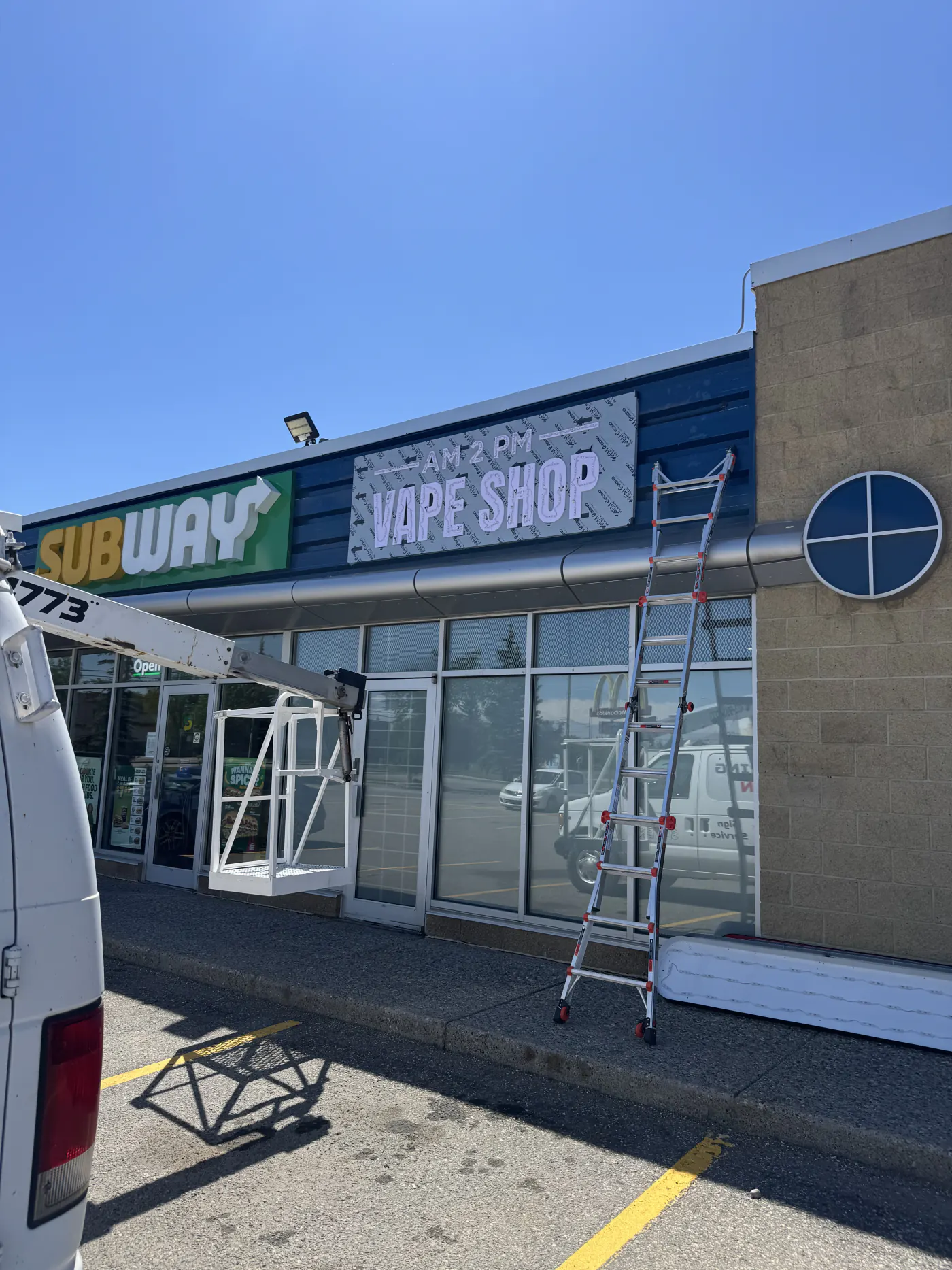
What Criteria Usually Cover
Every landlord writes their own, but most criteria cover some or all of the following:
Position and size
Where the sign goes (often a defined sign band), maximum width and height, and sometimes the maximum letter height or a share of the unit frontage.
Sign type
Some plazas require light boxes; others allow only channel letters, sometimes specifically on a raceway.
Lighting
Whether the sign must be illuminated, the lighting style allowed, and sometimes when it must be switched on.
Colours and finishes
Some criteria fix the colour of returns, raceways or backgrounds so the band looks uniform; logo colours are often free.
Fixing and electrical
How the sign is attached, where wiring may pass through the facade, and who connects the power.
Temporary and opening signs
Banners and “coming soon” signs are often covered too: where they may go and for how long. Check before you order one for the opening week.
Approval process
Most criteria require drawings to be approved before the sign is made and installed.
What to Ask Your Landlord Before Ordering
A short email to the property manager before the design starts can save a redesign later:
- The current sign criteria document, in writing
- The exact sign band or area for your unit
- Required sign type and lighting
- Any colour or finish requirements
- Whether the existing sign cabinet belongs to the landlord and can be reused
- Where power for the sign is available
- Who approves drawings and how long approval usually takes
- Any rules for window signs and temporary signs
Keep the answers in one email thread. When a question comes up later, from the City, from the installer or from a new property manager, you have the landlord’s position in writing, with dates. It also makes the design brief much faster: every answer on this list removes a guess from the first concept.
How to Stand Out Inside the Rules
When every tenant’s sign is the same size and type, small decisions make a big difference:
Use all of the allowed height
Letter height drives readability. If the band allows 24-inch letters, a design that uses 16-inch letters wastes the space. The guide how to choose letter height explains the distance rule.
Contrast beats colour
Strong contrast between letters and background reads further than a busy multicolour logo.
Keep the message short
Your name plus one word about what you do is easier to read than a full tagline.
Even, bright lighting
A light box with dark patches looks worse next to evenly lit neighbours. Good LED layout matters.
Choose the lighting carefully
If the criteria allow a choice, look at your neighbours. In a row of bright front-lit faces, a well-made halo-lit sign can stand out; in a row of quiet signs, bright faces win. See front-lit vs halo-lit.
Use the window
Window neon and window graphics are often less restricted than the facade and add presence after dark.
Taking Over a Unit: Reuse or Replace?
Many plaza units come with a sign cabinet left by the previous tenant. Before ordering a new one, check what can be reused.
| Situation | Usually the best option |
|---|---|
| Cabinet sound, face fine, graphics outdated | Graphics replacement: removal and reinstallation included |
| Cabinet sound, face cracked or yellowed | New acrylic face with new graphics |
| Cabinet sound, lighting failing | New lighting in the existing cabinet |
| Cabinet damaged | New light box to the criteria |
| Criteria require letters, not a cabinet | New channel letters, often on a raceway |
Before you decide, ask the landlord who owns the existing cabinet and whether it may stay. Some leases require the previous tenant’s sign to be removed; others treat the cabinet as part of the building. On the site visit we check the cabinet’s condition, the lighting inside and the fixings, so you know whether reuse is realistic.
Approval and Permits
Approval is usually quick when the drawings answer every question the landlord will ask: where exactly the sign goes, how big it is, what it is made of, how it is lit, how it is fixed and where the power comes from. Vague sketches lead to back-and-forth emails and lost weeks.
Most landlords approve drawings before a sign is made. Good drawings show the sign on your unit to scale, with dimensions, materials, lighting and fixing details. The same drawings are usually needed for a City permit, so preparing them once saves time.
If the landlord asks for changes, they are usually small: a different return colour, a slightly smaller sign, a different fixing. Because the drawings come from the same files used for production, revisions are quick and the approved drawing is exactly what gets built.
We handle all the sign permit paperwork: we prepare the drawings, specifications and documents and submit the application on your behalf. If you prefer to apply yourself, you get the complete package from us, ready to submit. For the City side of the process, read how to get a sign permit in Calgary.
Treat the Criteria as a Brief
Sign criteria are not an obstacle; they are a brief. Ask for them early, design to them from the first sketch, reuse what you can, and spend your effort on the things that make a sign readable: letter height, contrast and good lighting.
If the criteria are unclear or out of date, which happens in older plazas, ask the property manager to confirm the key points in writing: size, position, type and lighting. Having that confirmation before production protects you if questions come up after installation.
And keep the drawings. When you renew the lease, move units or open a second location in a similar plaza, approved drawings are a ready-made starting point.
Landlord Criteria Questions
Yes. We can install in the evening or on a weekend if the landlord prefers.
Ask the landlord to confirm in writing whether illuminated signs are allowed and when they may be on. It affects both the design and the electrical work.
Check your lease. In many leases the tenant pays for their own sign; some landlords contribute or supply a cabinet.
Yes. Send the criteria document and a photo of your unit; the design follows the criteria whoever wrote them.
Landlords can require that signs follow their criteria and usually approve drawings before installation. Designing to the criteria from the start avoids refusals.
Often yes, if it is sound and the landlord agrees. A new face or new graphics is usually much cheaper than a new cabinet.
Not always. Many criteria treat window signs separately. Ask your landlord.
Possibly. Landlord approval and City permits are separate. We handle all the sign permit paperwork: we prepare the drawings, specifications and documents and submit the application on your behalf. If you prefer to apply yourself, you get the complete package from us, ready to submit.
Sources
- City of Calgary: Land Use Bylaw 1P2007, Part 3, Division 5 (Signs), unofficial online copy, accessed 2026-10-28
- City of Calgary: Sign permits, accessed 2026-10-28