Front-Lit vs Halo-Lit Channel Letters: Which Should You Choose?
Once you decide on channel letters, the next question is almost always the same: should the letters glow, or should the wall behind them glow? Front-lit and halo-lit letters can spell the same name and still give a completely different impression.
This guide compares the two side by side (how they work, how they look day and night, where each one wins) so you can choose with confidence. There is also a third option that combines both.
- Free site visit & measurement
- Design included
- 2-year warranty
- Own workshop in Calgary
How Each Style Works
Front-lit
Each letter has a translucent face (3 mm milky acrylic) with LED modules inside. Light passes through the face, so the letter itself glows. Colours come from coloured acrylic or translucent film on the face.
Halo-lit (also backlit or reverse-lit)
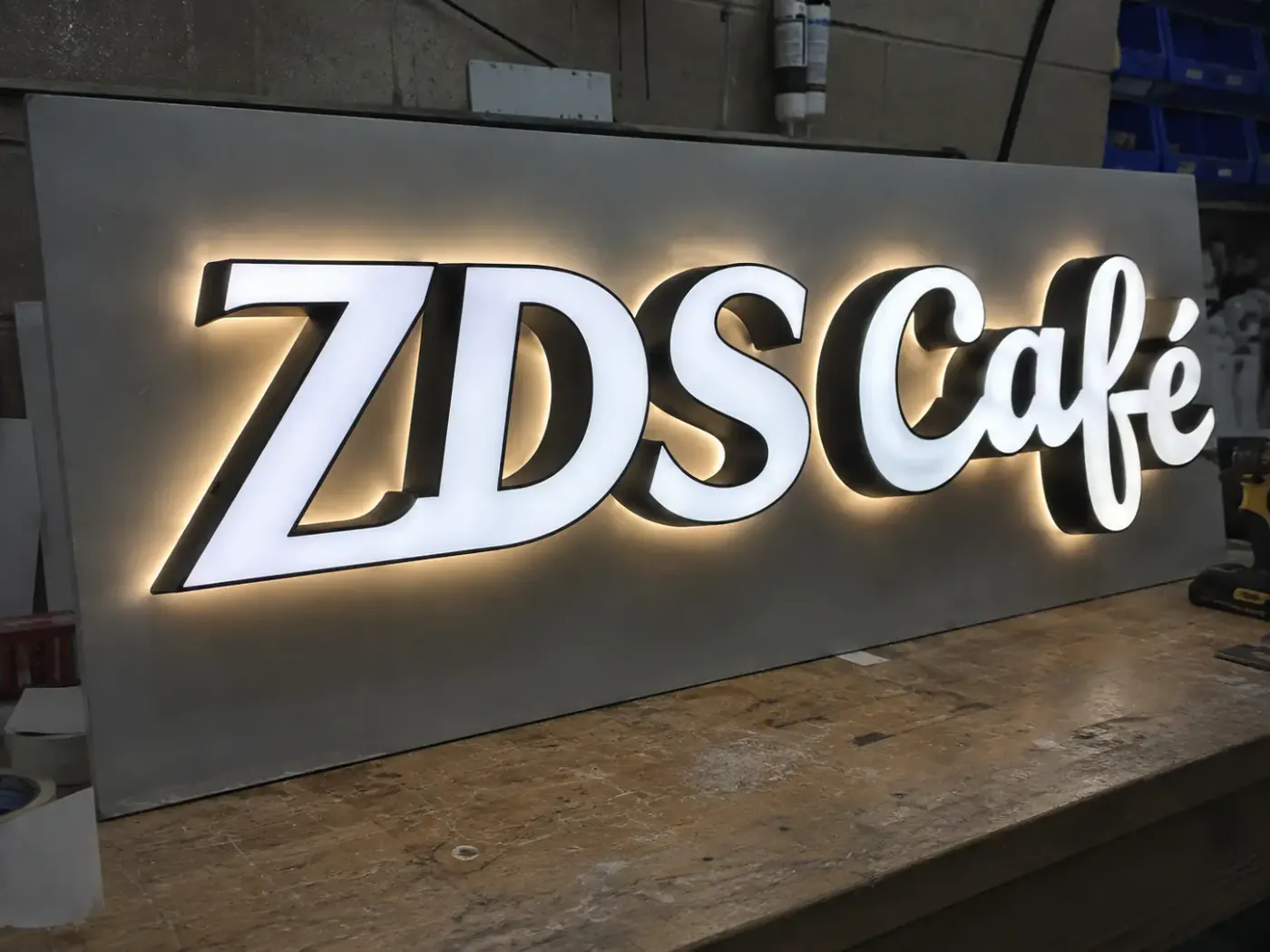
The face is solid and the light points backward. The letters are mounted slightly off the wall, so the light spreads onto the wall and forms a glowing outline around each letter.
The difference sounds small (light forward or light backward) but it changes almost everything about how the sign behaves: how far away it can be read, what it needs from the wall, how it looks in photos and how it feels to customers walking up to the door.
Both styles use the same LED modules rated for up to 50,000 hours and the same kind of letter bodies, so durability and running costs are similar. The choice is mostly about visibility and character.
Side-by-Side Comparison
| Front-lit | Halo-lit | |
|---|---|---|
| At night | Bright, readable faces; the name stands out strongly | Soft glowing outline on the wall; letters in silhouette |
| In daylight | Dimensional letters in the face colours | Solid dimensional letters in the face finish |
| Readability from far away | Strongest | Good at moderate distances |
| Look and feel | Bold, clear, energetic | Calm and refined |
| Wall requirements | Any wall colour or surface | Needs a smooth, not-too-dark wall, or a backer panel |
| Brand colours at night | Shown on the glowing face | Mostly seen by day; the halo carries the light at night |
| Price | Standard configuration starts from CAD $12 per inch of letter height, per letter, plus GST | The same rate as front-lit letters |
When Front-Lit Letters Win
- Your sign must be read from a road or a large parking lot
- You are in a plaza competing with bright neighbouring signs
- Your brand colours need to show at night
- The wall is dark, textured or uneven
- You open early or close late in winter and need maximum visibility
You can see front-lit letters on a dark backer panel in the barbershop project.
The standard front-lit option comes with a black body and a white 3 mm milky acrylic face.
Front-lit letters are also the most forgiving choice. Because the face carries the light, they look the same on red brick, grey stucco or black metal cladding, and they do not depend on how far they sit from the wall. If you are unsure about the wall or the distance, front-lit is the safe option.
The trade-off is character. A row of bright faces is clear, but it is also the look most storefronts already have. If your neighbours all use front-lit letters, your sign will compete on size and contrast rather than on style.
When Halo-Lit Letters Win
- You want a quieter look: boutiques, salons, offices, professional services
- The sign is seen from a sidewalk or a moderate distance
- The wall is smooth and light enough to show the halo
- You prefer no direct glare, for example near a patio or residences
- You want to stand out by being calmer than the bright signs around you
Halo lighting asks more of the site. The glow is only as good as the surface it lands on: a smooth, light wall shows a crisp, even outline; dark brick or deeply textured stucco swallows the light and makes the halo patchy. That is not a reason to give up on halo letters; a light, smooth backer panel behind the letters gives the light a reliable surface, but it should be planned from the start.
Distance matters too. A halo reads beautifully from the sidewalk and the parking lot, but from a fast road several hundred feet away it is softer than lit faces. For signs that must catch drivers, consider the combination described below.
The Third Option: Front & Halo-Lit
If you want the readability of lit faces and the depth of a halo, combination letters do both: the faces glow and the wall behind them glows too. They give the strongest presence at night and suit flagship locations and businesses that trade in the evening.
A combination is also a good answer when the site pulls you in two directions: the lit faces keep the sign readable from the road, while the halo adds the depth that makes it look finished from the sidewalk. Ask for it in the design concept and compare all three styles on the same photo.
They involve more lighting and a more involved build, so they cost 25% more. See front & halo-lit channel letters.
Five Questions to Decide
- How far away are people when they first see the sign?
- Is the wall smooth and light, or dark and textured?
- Do you trade mainly in daylight or after dark?
- Should the sign feel bold and energetic, or calm and quiet?
- Do your brand colours need to be visible at night?
If most answers point to distance, darkness and colour, choose front-lit. If they point to refinement and a good wall, choose halo-lit. If they point to both, consider the combination.
Mistakes to Avoid
Front-lit letters are the workhorse: bright, readable and economical. Halo-lit letters are quieter and more distinctive. Neither is better in general. One is better for your wall, your distance and your brand.
The fastest way to know is to see both on your own building. Send a photo and your logo and we will show you. Whichever you choose, these are the mistakes we see most often.
Letters that are too small
Lighting cannot fix undersized letters. The International Sign Association suggests at least one inch of letter height for every 25 feet of viewing distance. Read how to choose letter height before settling the size.
Halo letters on the wrong wall
A halo on dark brick looks weak and uneven. Check the wall first, or plan a backer panel.
Thin script on front-lit faces
Very thin strokes leave little room for light inside the letter. Script logos often work better slightly bolder, or as halo-lit or neon.
Forgetting the daytime look
Signs are seen for more hours in daylight than at night. Front-lit faces show your colours by day; halo-lit letters show their face finish. Decide what the sign should look like at noon as well as at 8 p.m.
Judging from a phone screen
Photos of illuminated signs online are often edited, or shot from an angle that flatters the halo. Judge a lighting style from where your customers actually stand. A design concept on a photo of your own storefront shows exactly that.
Skipping the power plan
Illuminated letters need power at the sign location. Where the power supply sits and how the wiring reaches it is part of the design, whichever style you choose.
Ignoring the plaza rules
Some landlords specify the lighting style. Read landlord sign criteria and check before you fall in love with a design.
Front-Lit vs Halo-Lit Questions
Yes. The halo is light reflected from the wall behind the letters, so it works in any season, as long as the wall surface suits it.
Not by changing a part. The faces and lighting are built differently. It is worth deciding before production; a design concept shows the options on your building.
Check the landlord’s sign criteria first: some specify the lighting. Where you have a choice, front-lit letters usually compete best with bright neighbours, and halo-lit letters stand out by being calmer.
Front-lit letters, because the light shines straight through the face toward the viewer.
Neither: front-lit and halo-lit letters cost the same, starting from CAD $12 per inch of letter height, per letter, plus GST. Front & halo lighting together costs 25% more.
Rough or dark brick weakens the halo. A light, smooth backer panel behind the letters solves it.
The faces can be finished in your colours for daytime. The night look depends on the halo light.
Both use LED modules rated for up to 50,000 hours and carry the same 2-year warranty.