
How Long Do LED Signs Last, and What Fails First?
A sign is a long-term investment, so it is fair to ask how long it will keep working before it needs money spent on it. Most illuminated signs today use LEDs, and LEDs have a reputation for lasting “forever.” They do not. But they do last a long time, and they age in a predictable way.
This guide explains what LED ratings mean in real years, how LEDs actually wear out, which other parts of a sign matter, and what you can do to keep your sign bright.
- Free site visit & measurement
- Design included
- 2-year warranty
- Own workshop in Calgary
The Short Answer
The LED modules we use in channel letters are rated by their manufacturer for up to 50,000 hours. That is a rating, not a guarantee, but it is useful for planning. At 12 hours a day, 50,000 hours is a little over 11 years.
The sign itself lasts longer than the LEDs inside it. A well-made sign can serve 10 years and more: when the LED modules reach the end of their rated life, they are replaced, and the sign stays on the wall. Real-world LED life depends heavily on how the sign is built and used.
For a business, that is one of the reasons a good illuminated sign is a long-term purchase: built well, the lighting keeps working through many Calgary winters before it needs attention, and the sign keeps doing its job every evening without you thinking about it.
What 50,000 Hours Means in Years
The same rating means very different things depending on how many hours a day the sign is on. This is simple arithmetic: 50,000 hours divided by hours per day and 365 days:
| Hours on per day | Typical use | Years to reach 50,000 hours |
|---|---|---|
| 6 | Evening hours only | about 22.8 |
| 8 | Business hours in winter | about 17.1 |
| 12 | Dusk to late night | about 11.4 |
| 24 | Always on | about 5.7 |
The lesson is practical: a timer or photocell that switches the sign off when nobody is around can make the same LEDs last years longer. In Calgary, where winter evenings are long, a sign may be on for many hours a day for much of the year, so the switching schedule matters.
How LEDs Age: Dimming, Not Sudden Failure
Old-style bulbs and tubes worked until they suddenly did not. LEDs are different: they mainly fail by slowly dimming over time, not by burning out all at once.
For a sign owner this means two things. First, an LED sign rarely goes from fully lit to dark overnight because the LEDs wore out; it gets gradually less bright over years. Second, because the change is slow, it is easy to miss: a sign can be noticeably dimmer than when it was installed before anyone mentions it.
It also means that when a sign does go dark all at once, or a whole section stops lighting, the cause most likely lies elsewhere in the system rather than in LEDs simply wearing out, which is why it is worth understanding the other parts.
The Parts of an LED Sign and What Can Go Wrong
An illuminated sign is a system. Each part has its own job and its own reasons to need attention:
LED modules
The light source. They age by dimming, and their life is shortened by heat and by running at higher currents.
Power supply
LEDs cannot simply be plugged into the mains: the current through them has to be regulated, or they get damaged. The power supply does that job. If it stops working, the LEDs it feeds go dark together.
Wiring and connections
Every sign has connections between modules, between letters and to the power supply. A loose or damaged connection can make one letter or one section go dark while the rest keep working.
Faces and graphics
Acrylic faces and printed graphics live outdoors in sun and cold. Over the years a face can fade, yellow or crack. That is not a lighting fault, but it makes the sign look dimmer and older.
Structure and fixings
Letter bodies, cabinets and their fixings hold everything together and keep weather out. Damage from impacts or severe weather can let water in and affect the electrics.
What Makes an LED Sign Last Longer
Most of what decides an LED sign’s life is decided in the workshop, before the sign reaches your wall:
- Heat management: LEDs need proper heat dissipation to last, and their performance depends largely on the operating temperature
- Correct current: LEDs driven harder run hotter, and “heating also increases with higher currents, which compromises LED lifetime”
- A properly sized power supply that regulates the current to the LEDs
- Good connections and tidy wiring that are protected from water and movement
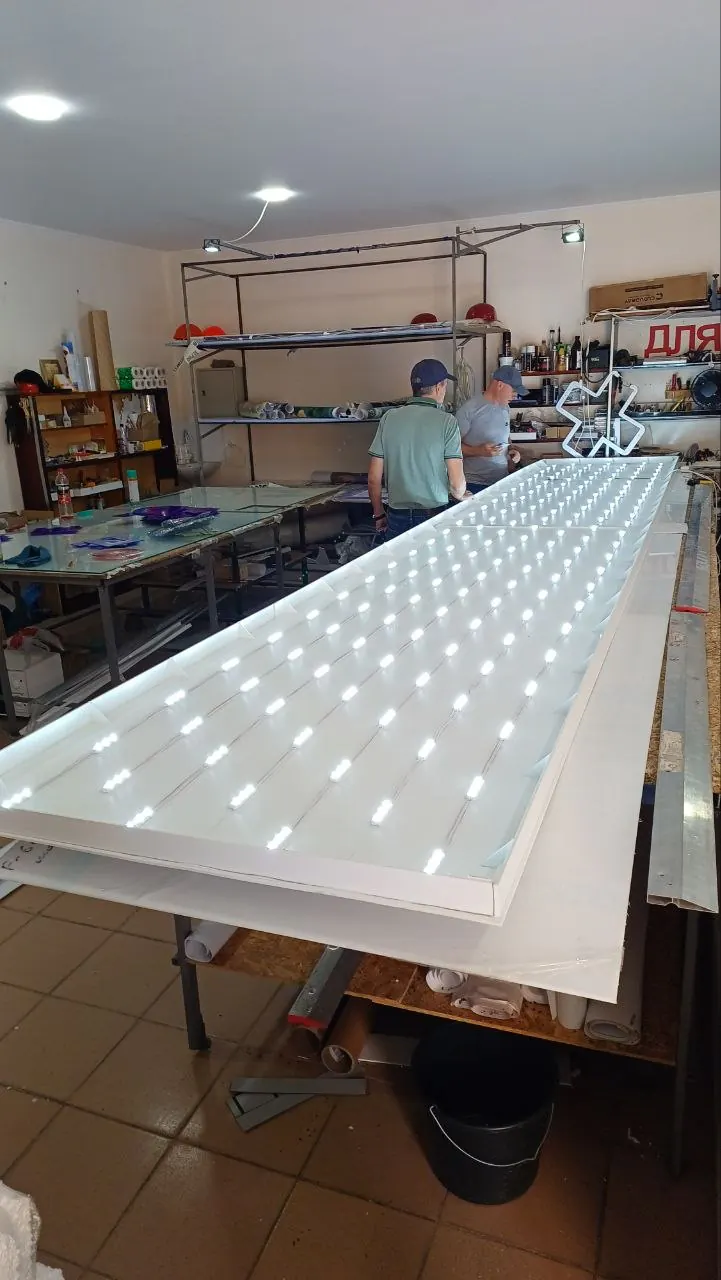
- Testing before installation: every illuminated sign we make is assembled and switched on in the workshop before it goes on the wall
Switching is not a problem. LEDs handle frequent on-off cycling well, so using a timer to turn the sign off overnight costs nothing in LED life, and saves hours of wear.
Simple Care for Sign Owners
You do not need to maintain an LED sign the way old neon or fluorescent signs needed it. A few habits help:
- Use a timer or photocell so the sign is only on when it is useful
- Look at the sign at night every few months, from where customers see it
- Watch for one letter or section that is darker than the rest
- Check the sign after severe storms or hail for visible damage
- Keep the face reasonably clean: dirt on a face looks like dim lighting
- Do not open the sign or work on the wiring yourself; call the maker
If a light box looks dimmer and yellower than it used to, the face may be the issue rather than the LEDs. The guide light box re-face vs a new cabinet explains the options.
Warranty and Repairs
Every sign we make carries a 2-year warranty covering the LED lighting, power supply, sign structure, materials and installation. The warranty does not cover severe weather, accidental damage and vandalism.
If something does stop working, describe what you see (the whole sign, one letter or one section, steady or flickering) and send a photo or a short video at night. That usually narrows the cause down before anyone climbs a ladder.
Because we design, build and install every sign in-house, the company that answers your call is the company that built your sign. That makes diagnosing a problem simpler: we know how the lighting, the power supply and the wiring are laid out inside.
Choosing a sign with good LED lighting is one of the best ways to protect the investment. See how lighting is built into channel letters, light boxes and LED neon.
LED Sign Life Questions
Yes, gradually. LEDs mainly age by dimming, so a sign slowly loses some brightness over its life. Good heat management and correct current slow this down.
Only if it is useful to you. Every hour the sign is on counts toward the LEDs’ rated life, so switching it off when nobody is around makes it last longer.
Because the change is slow, it is hard to see day to day. Compare the sign at night with a photo taken soon after installation, from the same spot. If one part looks darker than the rest, that is worth a call.
The manufacturer rates the LED modules used in our channel letters for up to 50,000 hours. Real life depends on build quality, heat and how many hours a day the sign is on.
Usually not. LEDs mainly fail by dimming over time rather than failing abruptly.
No. The sign can serve 10 years and more. When the LED modules reach the end of their rated life, they are replaced and the sign stays on the wall.
Because LEDs usually dim gradually, a sign that goes dark all at once points to another part of the system, such as the power supply or a connection. It should be checked by the sign maker.
No. LEDs are well suited to frequent on-off cycling, so a timer is a good idea.
The 2-year warranty covers the LED lighting, power supply, sign structure, materials and installation. It does not cover severe weather, accidental damage and vandalism.
Sources
- Creon Design: LED modules and warranty, accessed 2026-10-28